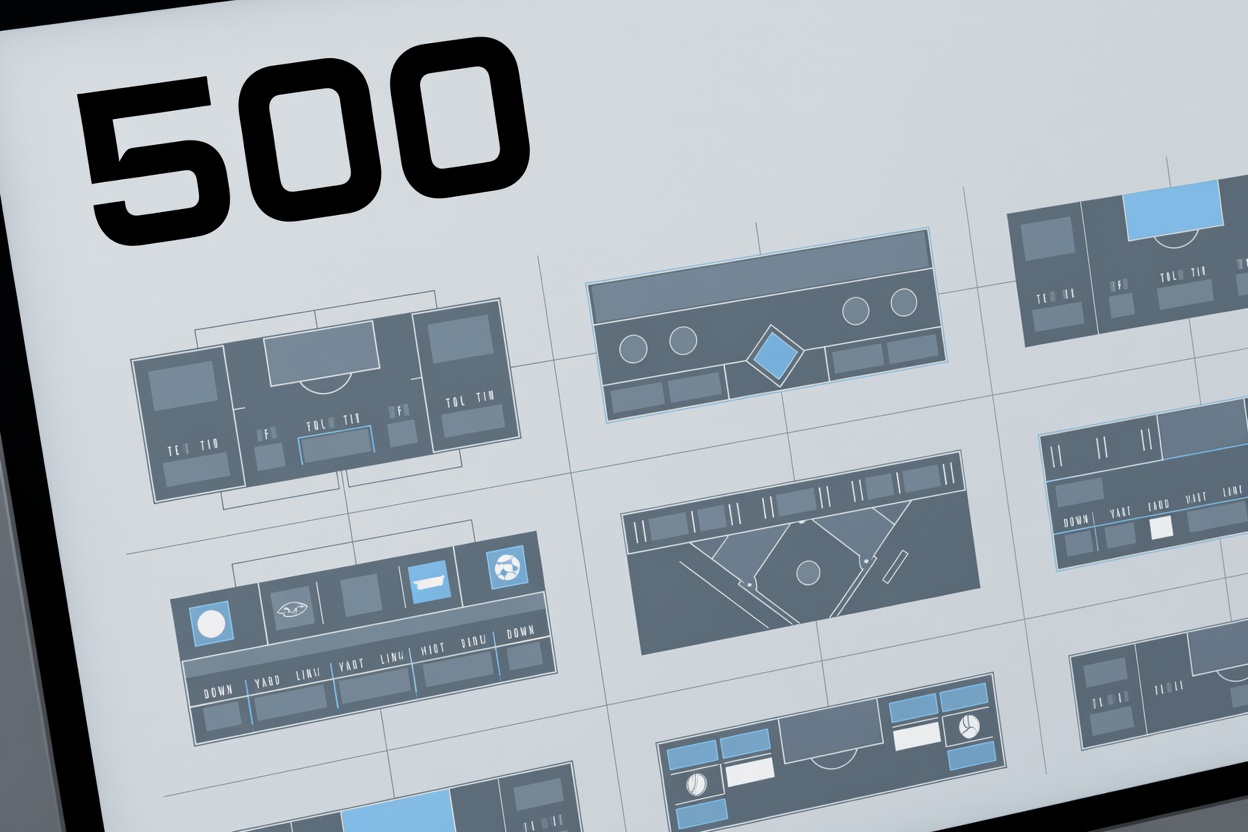
SPORT-SPECIFIC LAYOUT LOGIC
The following examples illustrate typical field ordering. These are structural templates. They represent interface blueprints, not real match data.
Football
HOME — AWAY — SCORE — MINUTE — STATUS
Focuses on low-scoring increments and a continuous ascending match clock. Halves dictate the primary structural periods. Extra time adds appended digits.
Basketball
HOME — AWAY — SCORE — QUARTER — CLOCK
Requires high-frequency score updates. The descending clock demands millisecond precision in the final minute. Quarters divide the match structure.
Tennis
PLAYER — SETS — GAMES — POINT
Utilizes a nested progression. Points feed into games. Games feed into sets. Matrix layouts display horizontal progression across multiple sets simultaneously.
Ice Hockey
HOME — AWAY — SCORE — PERIOD — CLOCK
Similar to basketball but divided into three standard periods. Penalty clocks often integrate into secondary display panels adjacent to the main time.
Volleyball
TEAM — SETS — POINTS — SET
Focuses on target scores per set. Winning a predefined point total secures the set block. Match victory requires a fixed number of set blocks.
Handball
HOME — AWAY — SCORE — HALF — CLOCK
Combines high-frequency scoring with a continuous clock format. Suspension timers frequently appear in the operator interface next to team rosters.
STATUS LABELS
Status signals provide instant context for the numerical data. The primary states encompass LIVE, FINAL, SCHEDULED, POSTPONED, and CANCELLED. Secondary states handle temporary flow alterations. DELAYED indicates unexpected stoppage. HALF-TIME signals scheduled intermissions. TIMEOUT denotes requested strategic pauses.
The scoreboard maintains operational discipline. Avoid descriptive text. Utilize precise tags. Let the structural layout inform the viewer.